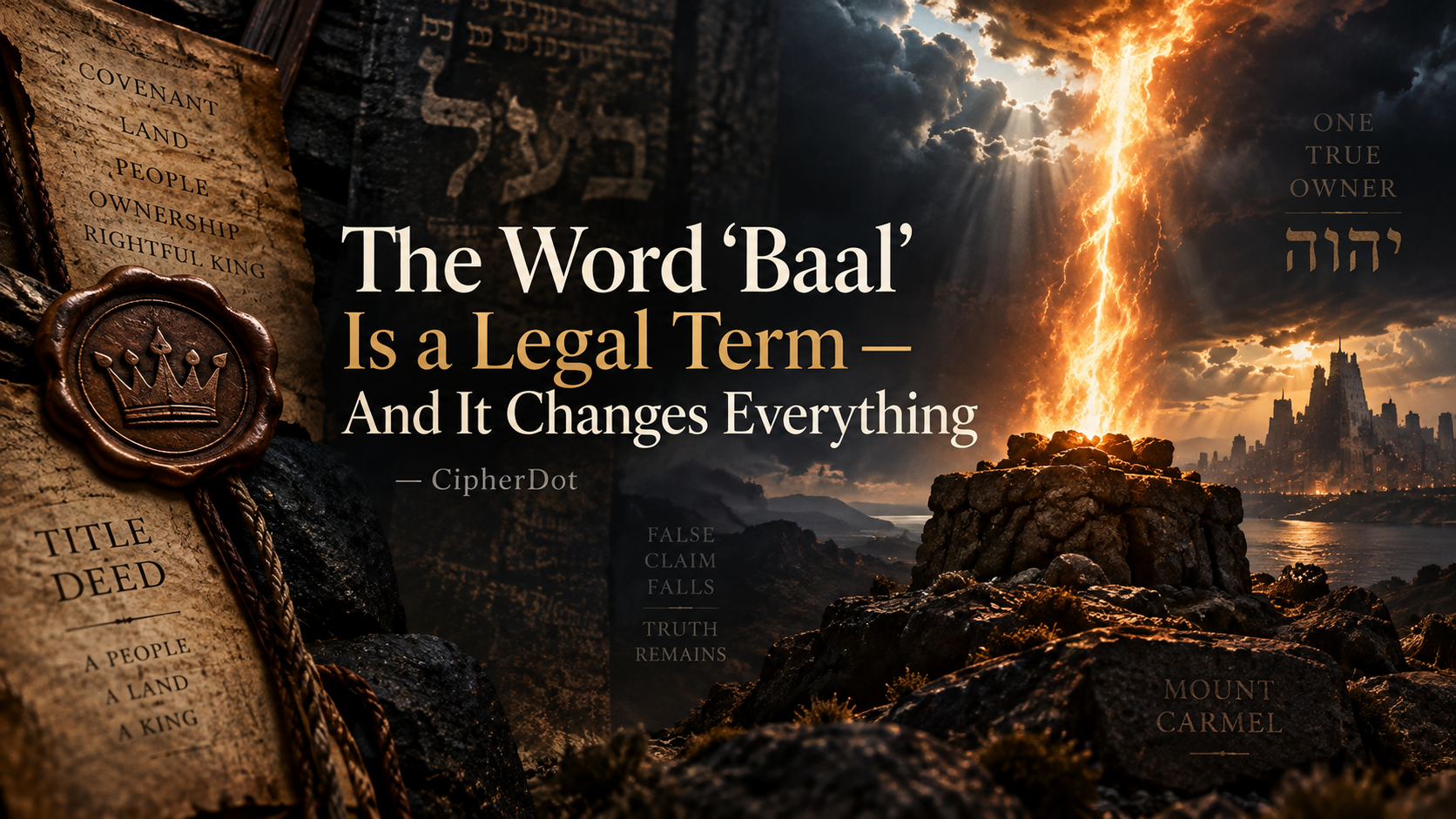
I was doing a deep dive into Strong’s H1167 and H1168 this week and I have to share what I found because it completely reframed how I read the entire Old Testament.
Most people hear “Baal” and think — pagan god, idol worship, bad. And yes. But the root word tells a story that goes so much deeper than that.
Ba’al Literally Means “Owner”
H1167 — the root — is a legal and relational term. It means lord, master, owner, husband, possessor. It shows up in Torah as a property law word.
- Ba’al habayit — master of the house
- Ba’al hasadeh — owner of the field
- Ba’al chalom — master of dreams (what Joseph’s brothers called him in Genesis 37)
Here’s what stopped me cold: the word works both directions. You can own something — or be owned by it. Whatever defines or masters you, you are its ba’al.
So when the Phoenician entity in H1168 took the name Baal — he wasn’t just saying “worship me.” He was filing a legal ownership claim. Over the land. Over the rain. Over the harvest. Over the people.
He called himself: The Lord. The Master. The Owner.
That Makes Mount Carmel a Title Dispute
Elijah vs. the prophets of Baal on Mount Carmel (1 Kings 18) isn’t just a dramatic miracle story. It’s a cosmic court case.
The question on the table: Who is the actual owner of the fire? Of the rain? Of Israel?
And YHWH answers with fire.
Elijah’s own name means “My God is YHWH” — his very identity was the declaration of the contest before it even started.
Hosea Makes Complete Sense Now
Hosea 2:16 hit me completely differently after this study.
YHWH says: “In that day you will call me ‘my husband’ (ishi) and no longer call me ‘my master’ (ba’ali).”
Two words for the same relational role:
- Ishi — my man. Intimate. Personal. Covenant.
- Ba’ali — my lord/master. Legal. Hierarchical. Ownership language.
YHWH isn’t removing His authority. He’s reframing the relationship — from legal ownership to covenant intimacy.
And He deliberately retires the ba’al title because the entity had contaminated it so thoroughly it could no longer carry clean meaning.
The True Owner refused the title the false one corrupted.
It Runs All the Way to Revelation
Here’s where it clicked into the Babylon system for me.
Revelation 17:5 — the Whore is called “THE MOTHER OF PROSTITUTES.” That’s Asherah language — the divine mother, the source, the one from whom the harlotry flows.
Revelation 18:7 — “In her heart she says, I sit as queen; I am no widow, and I will never mourn.”
That is ba’al language. She’s claiming:
- Queenship — I am the ruling owner
- No widowhood — my lord/ba’al is still with me
- No mourning — my dominion is secure
Isaiah 47 said the exact same thing about Babylon centuries earlier. John recognized the same spirit in its final form.
The Through-Line Is One Question
From Genesis to Revelation, the entire biblical narrative is one continuous ownership dispute.
Every false system — Baal, Molek, Babel, Jezebel, Babylon — is asserting the same counterfeit claim over creation, the nations, the seed, humanity.
Every divine judgment is YHWH enforcing His rightful title.
The Cross is the final title deed. Colossians 2:15 — He disarmed the rulers and authorities and made a public spectacle of them. Every false ownership claim legally dismantled at the source.
And Revelation 11:15 isn’t a new announcement —
“The kingdom of the world has become the kingdom of our Lord and of His Christ, and He shall reign forever and ever.”
That’s a coronation of what was always true.
The ownership was always His. The usurpation is finished.
— Spitfire/Cipherdot studies
Leave a Reply